
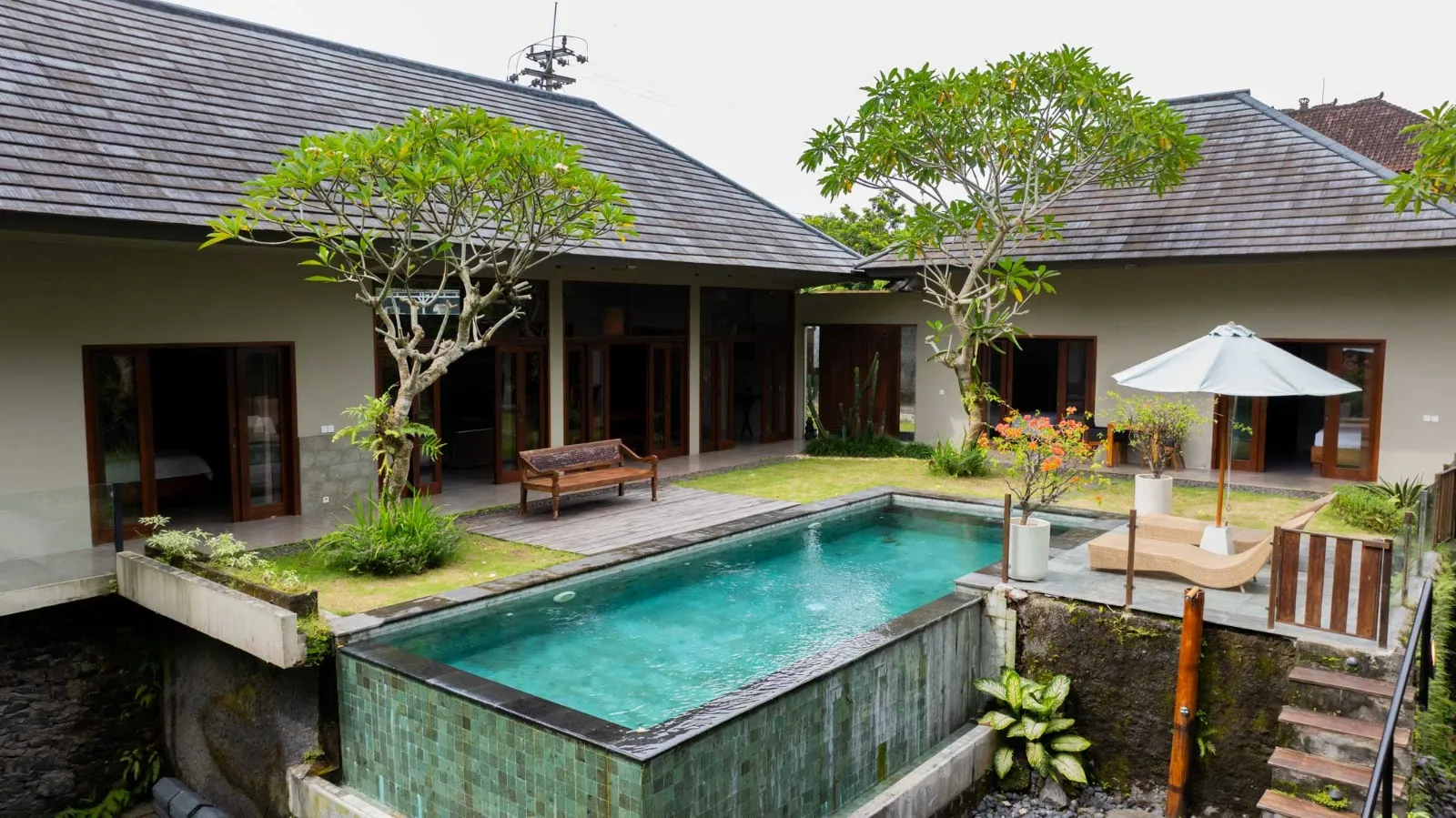
If you love the idea of Canggu and Pererenan but not the noise, traffic, or constant buzz, Cepaka is the soft landing. It’s a small village area in Tabanan where daily life still feels local: rice fields, roosters in the morning, temple days, and narrow roads lined with frangipani trees.
You’re close enough to join the Pererenan lifestyle whenever you want, but far enough that when you come home, it’s genuinely calm. Many stays and villas here position Cepaka as a quiet residential pocket around 10–15 minutes from Pererenan/Canggu in lighter traffic, with commute time stretching longer during peak hours.
The vibe in one sentence
Green, slow, residential, and quietly convenient.
Cepaka doesn’t try to be trendy. It’s the place where you hear the wind in the palms and see farmers moving through the subak paths. It’s common to find homes tucked behind rice paddies, gardens, and small rivers, with a more “local village” rhythm than the beach zones.
What a normal day feels like in Cepaka
Morning
Mornings tend to be early and bright. You’ll hear birds, roosters, and the occasional motorbike, but not the constant traffic hum you get closer to the coast. Many people start the day with a walk along the small lanes near the rice fields, or a quiet coffee at home with a view of green.
If you’re a remote worker, this is the best part: it’s easier to focus here. The environment naturally feels less “social pressure” than Canggu, where every coffee can turn into a hangout.
Midday
Midday is hot, slow, and practical. You’ll likely do errands either in nearby village shops or head out toward Pererenan/Canggu for bigger grocery runs, gym classes, cafés, or meetings. The main trade-off: you’ll drive more than if you live in central Pererenan.
Evening
Evenings are peaceful. In Pererenan you’ll find sunsets, restaurants, and the social scene (it’s known for a more laid-back vibe than Canggu while still having great spots).
Then you come back to Cepaka and it’s quiet again. That contrast is exactly why many people choose it.
Food, cafés, and “daily essentials”
Cepaka itself is not a café hub, but it has local warungs and a growing list of small eateries in the wider area. Tripadvisor’s Cepaka listings show a mix of casual local spots and a few international options popping up around the village.
Most residents do a simple routine:
• Quick meals nearby (warungs and local minimarts)
• Go out for “nice” meals in Pererenan/Canggu
• Keep delivery apps (Grab/Gojek) as a backup, especially at night (availability is generally good in Pererenan and extends outward, but can be slower deeper into village areas).
Getting around
Cepaka works best if you’re comfortable with short drives. Many listings describe it as close to Pererenan/Canggu and Seseh, commonly quoted around 10–15 minutes in lighter traffic.
Also, Tanah Lot is a popular nearby landmark for sunsets and quick outings, often described as a short drive from the Pererenan side of the area.
Who Cepaka is perfect for
Cepaka is a strong fit if you are:
• A remote worker who wants focus and quiet
• A couple or small family who values space and greenery
• Someone who loves Pererenan, but wants to sleep well
• An owner/investor looking for a calmer “residential + nature” positioning (some properties highlight rice field views and retreat-style appeal)
Less ideal if you are:
• Someone who wants to walk to cafés, beach clubs, or nightlife daily• Highly social and happiest in the middle of the action
The honest pros and cons
Pros
• Noticeably quieter than coastal hotspots
• More greenery and “real Bali” neighborhood feel
• Often better value for space compared to prime Pererenan
• Great for wellness routines and long stays
Cons
• You’ll rely on driving for many daily activities
• Peak-hour traffic can still impact your commute into Pererenan/Canggu
• Fewer “walkable” lifestyle options right at your doorstep
If you love the idea of Canggu and Pererenan but not the noise, traffic, or constant buzz, Cepaka is the soft landing. It’s a small village area in Tabanan where daily life still feels local: rice fields, roosters in the morning, temple days, and narrow roads lined with frangipani trees.
You’re close enough to join the Pererenan lifestyle whenever you want, but far enough that when you come home, it’s genuinely calm. Many stays and villas here position Cepaka as a quiet residential pocket around 10–15 minutes from Pererenan/Canggu in lighter traffic, with commute time stretching longer during peak hours.
The vibe in one sentence
Green, slow, residential, and quietly convenient.
Cepaka doesn’t try to be trendy. It’s the place where you hear the wind in the palms and see farmers moving through the subak paths. It’s common to find homes tucked behind rice paddies, gardens, and small rivers, with a more “local village” rhythm than the beach zones.
What a normal day feels like in Cepaka
Morning
Mornings tend to be early and bright. You’ll hear birds, roosters, and the occasional motorbike, but not the constant traffic hum you get closer to the coast. Many people start the day with a walk along the small lanes near the rice fields, or a quiet coffee at home with a view of green.
If you’re a remote worker, this is the best part: it’s easier to focus here. The environment naturally feels less “social pressure” than Canggu, where every coffee can turn into a hangout.
Midday
Midday is hot, slow, and practical. You’ll likely do errands either in nearby village shops or head out toward Pererenan/Canggu for bigger grocery runs, gym classes, cafés, or meetings. The main trade-off: you’ll drive more than if you live in central Pererenan.
Evening
Evenings are peaceful. In Pererenan you’ll find sunsets, restaurants, and the social scene (it’s known for a more laid-back vibe than Canggu while still having great spots).
Then you come back to Cepaka and it’s quiet again. That contrast is exactly why many people choose it.
Food, cafés, and “daily essentials”
Cepaka itself is not a café hub, but it has local warungs and a growing list of small eateries in the wider area. Tripadvisor’s Cepaka listings show a mix of casual local spots and a few international options popping up around the village.
Most residents do a simple routine:
• Quick meals nearby (warungs and local minimarts)
• Go out for “nice” meals in Pererenan/Canggu
• Keep delivery apps (Grab/Gojek) as a backup, especially at night (availability is generally good in Pererenan and extends outward, but can be slower deeper into village areas).
Getting around
Cepaka works best if you’re comfortable with short drives. Many listings describe it as close to Pererenan/Canggu and Seseh, commonly quoted around 10–15 minutes in lighter traffic.
Also, Tanah Lot is a popular nearby landmark for sunsets and quick outings, often described as a short drive from the Pererenan side of the area.
Who Cepaka is perfect for
Cepaka is a strong fit if you are:
• A remote worker who wants focus and quiet
• A couple or small family who values space and greenery
• Someone who loves Pererenan, but wants to sleep well
• An owner/investor looking for a calmer “residential + nature” positioning (some properties highlight rice field views and retreat-style appeal)
Less ideal if you are:
• Someone who wants to walk to cafés, beach clubs, or nightlife daily• Highly social and happiest in the middle of the action
The honest pros and cons
Pros
• Noticeably quieter than coastal hotspots
• More greenery and “real Bali” neighborhood feel
• Often better value for space compared to prime Pererenan
• Great for wellness routines and long stays
Cons
• You’ll rely on driving for many daily activities
• Peak-hour traffic can still impact your commute into Pererenan/Canggu
• Fewer “walkable” lifestyle options right at your doorstep
